Project study · VEIL / 006
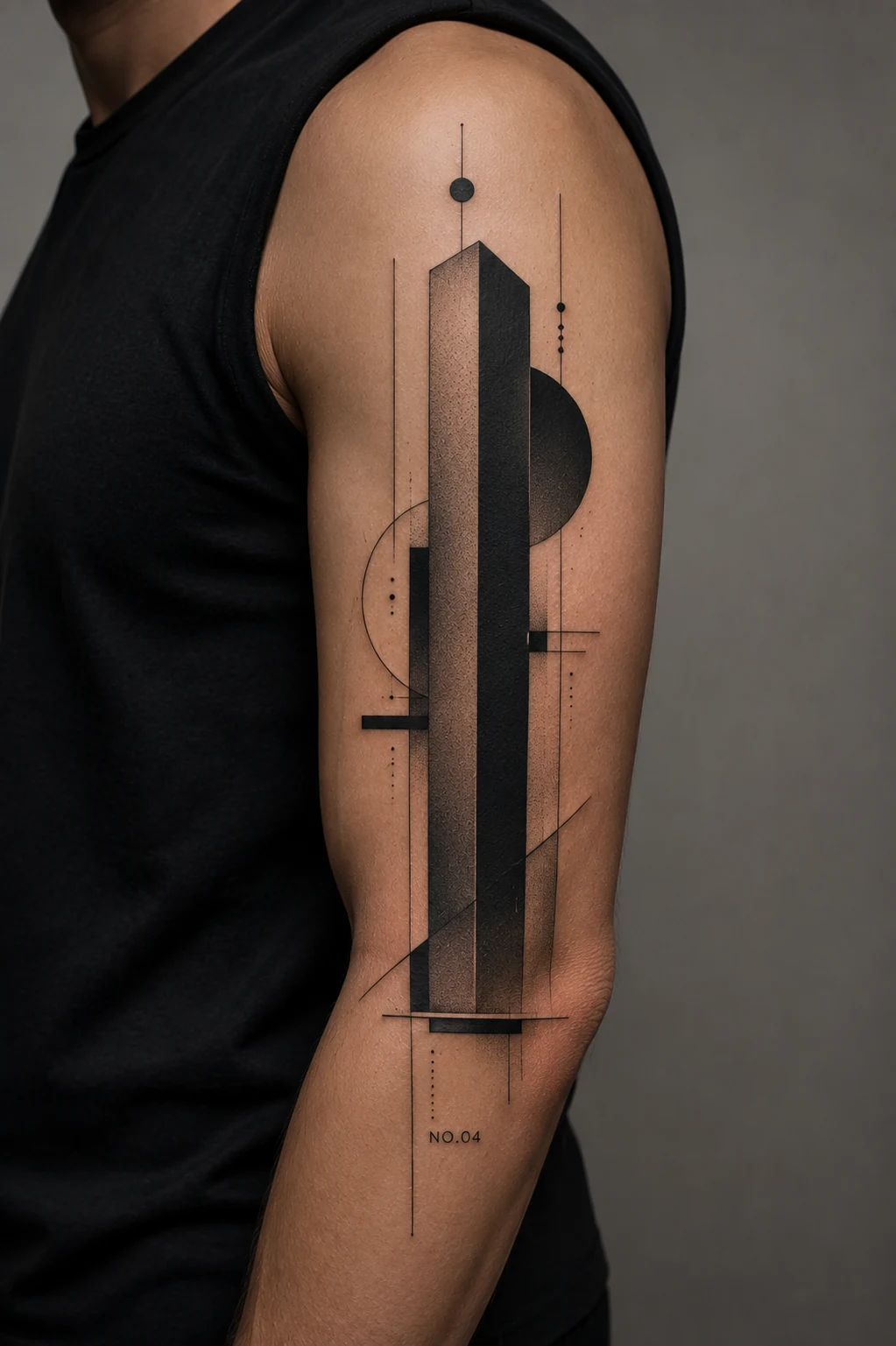
Monolith No. 04
Monolith No. 04 builds one tall architectural figure on the outer upper arm. A dense central mass, softened grey planes, circles, and fine axes run from the shoulder toward the elbow, with the small NO.04 mark acting as a deliberate study-series notation inside the artwork.
- Placement
- Upper arm
- Scale
- Large
- Session profile
- Planned across sessions
Project index
The work in context.
A vertical architectural blackwork study balances a dominant mass with circles, thin axes, and a small NO.04 notation.
A tall black-and-grey architectural mass is cut by circles, fine construction lines, and narrow open passages on the outer upper arm.
- Artist
- Niko Vale
- Discipline
- Blackwork
- Placement
- Upper arm
- Body orientation
- Outer
- Scale
- Large
- Session profile
- Planned across sessions
01 · Client brief
What the work needed to hold.
The request was for a large, severe blackwork composition with no illustrative subject. It needed to occupy the outer upper arm as one elongated form, carry weight near the shoulder, resolve before the elbow, and remain legible as the arm rotated.
02 · Creative tension
The question inside the design.
A monolithic impression can easily become a single inert block. The creative task was to preserve weight while introducing enough division for the body to animate it. Shifted axes allow stability and disruption to exist at the same time.
03 · Anatomy and movement
Composed with the body, not over it.
A primary vertical field follows the arm's long axis. Its upper edge answers the shoulder curve, while the lower planes narrow toward the elbow; circles and fine lines are checked from front and side so the structure appears tall rather than flat.
04 · Composition development
Four decisions toward one structure.
The composition developed by assigning each surface a role: dominant mass, shaded transition, circular interruption, fine construction mark, or release. The NO.04 notation was retained as an internal series marker, not as evidence of a real institutional archive.
Composition stage 01
Mass
A large vertical field establishes the weight and total reach of the upper-arm structure.
Composition stage 02
Arrangement
The mass divides into coherent surfaces connected by uninked passages rather than decorative cuts.
Composition stage 03
Dislocation
Secondary planes move onto shifted shoulder axes so arm rotation visibly changes their alignment.
Composition stage 04
Coherence
Black density, edge placement, and open bands resolve as one large structure across two moving surfaces.
05 · Technical approach
How the visual system is protected.
Division of the form
Major areas are organised as logical surfaces so each stage contributes a complete structural passage.
Black-field consistency
Density and boundaries are assessed directly on the body, with the intended weight protected across the full scale.
Shifted axes
Alignment is tested with the arm resting, rotating, and lifting so dislocation remains deliberate rather than accidental.
06 · Session path
A plan responsive to the work.
The large project is planned across sessions following the composition’s logical surfaces. This allows each black field and boundary to be approached coherently, with later stages confirmed after the preceding work has settled.
07 · Healing perspective
Care remains individual.
The staged plan leaves room for recovery between larger passages. Aftercare, the scope of each return, and timing are assessed individually rather than promised as a fixed sequence in advance.
Read healing and preparation guidance08 · Artist reflection
What remains in the finished work.
The work is most alive where a thin construction line crosses the heavy central mass. That contrast makes the arm feel longer and keeps the monolith from becoming one inert block.
Closing perspective
A direction for a new conversation.
Monolith No. 04 derives its weight from proportion, then lets movement disturb the certainty of the geometry.
Add this study as context for your consultation. It will help describe a sensibility while your own work is developed for your body and story.
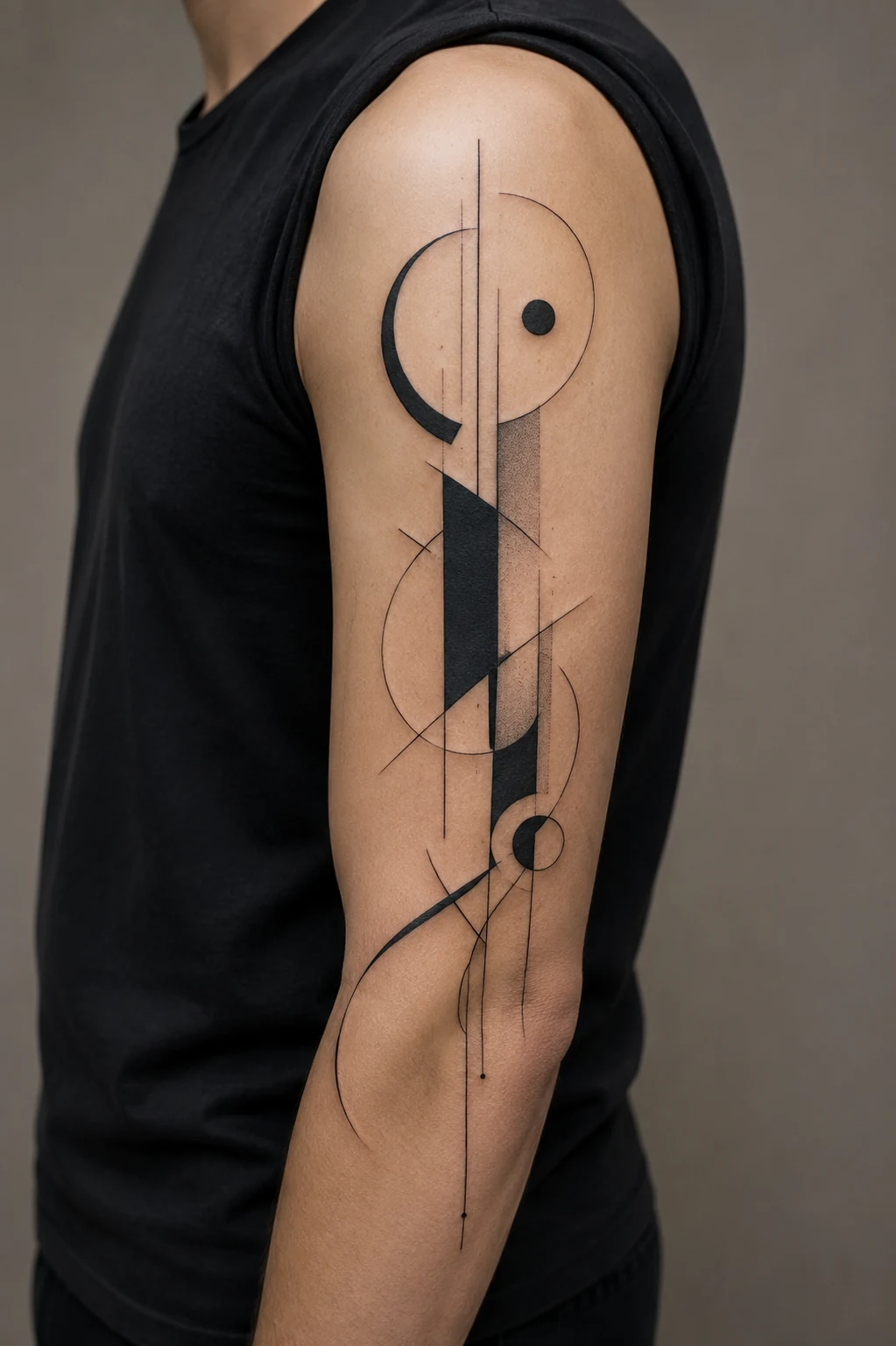
Quiet Architecture
- Artist
- Niko Vale
- Discipline
- Blackwork
- Placement
- Upper arm
- Scale
- Large
- Session profile
- Planned across sessions
Geometric blackwork balances circles, black planes, and uninked skin along the outer upper arm.
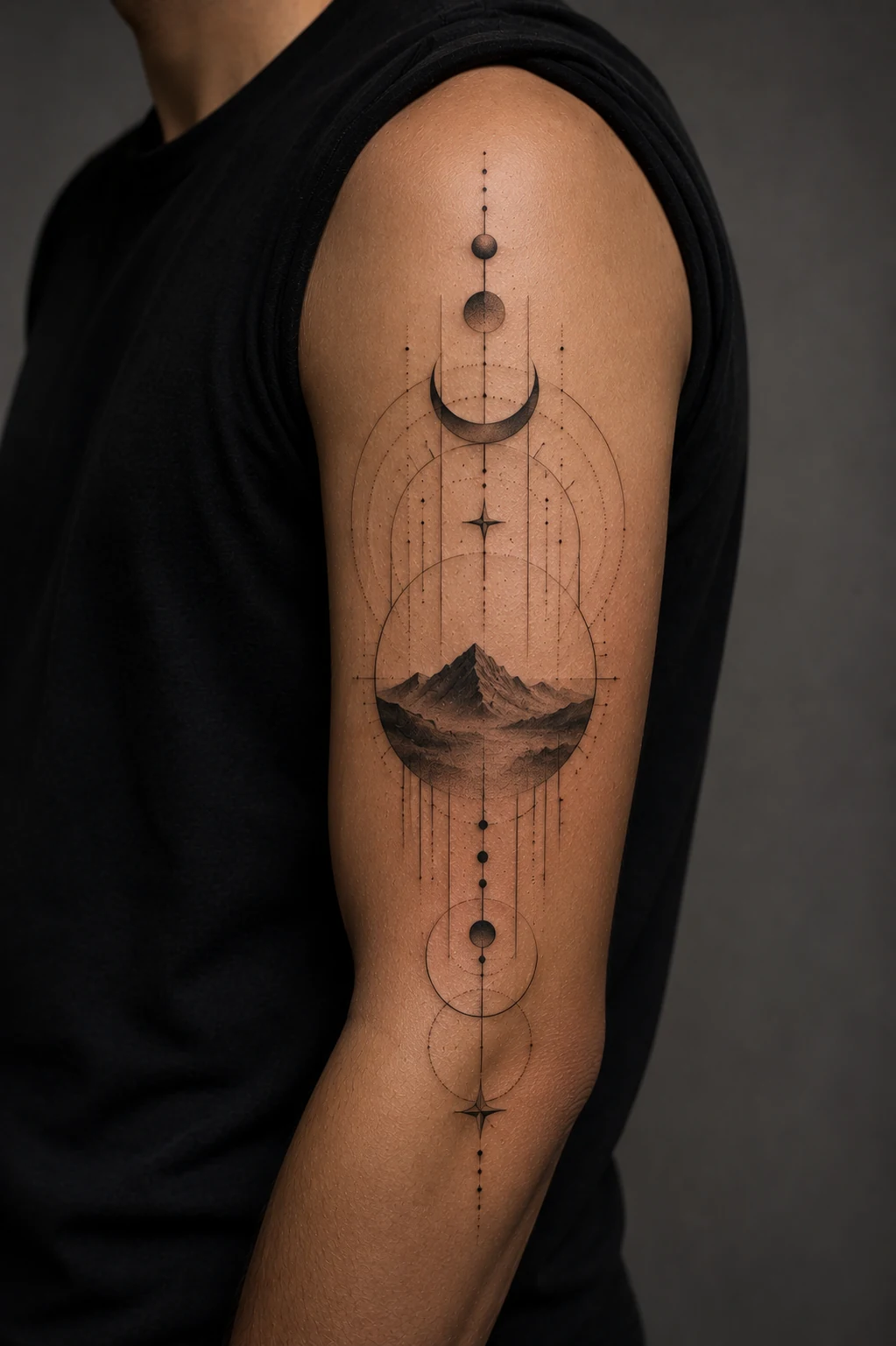
Veiled Narrative
- Artist
- Adrian Roe
- Discipline
- Illustrative
- Placement
- Upper arm
- Scale
- Large
- Session profile
- Planned across sessions
A restrained mountain fragment sits within a fine geometric veil of circles, crescents, and precise lines.

Second Skin
- Artist
- Adrian Roe
- Discipline
- Illustrative
- Placement
- Upper arm
- Scale
- Large
- Session profile
- Planned across sessions
A classical stone profile emerges through a wing, leaves, and broken sculptural layers in soft black and grey.