Project study · VEIL / 001
Quiet Architecture
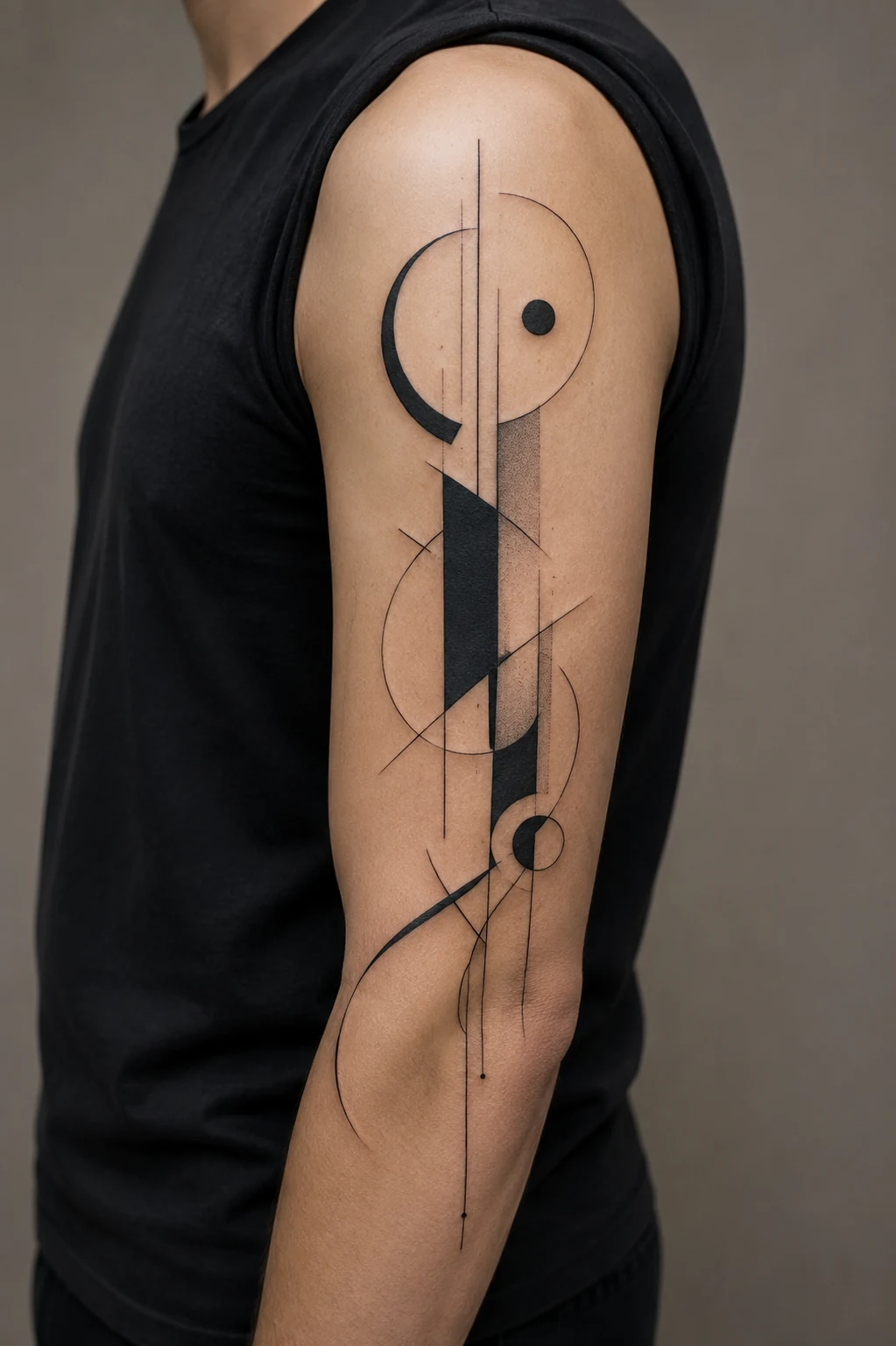
Quiet Architecture builds a calm geometric route along the outer upper arm. Circles, arcs, fine lines, solid planes, and untouched skin remain distinct up close while resolving into one vertical structure from a distance.
- Placement
- Upper arm
- Scale
- Large
- Session profile
- Planned across sessions
Project index
The work in context.
Geometric blackwork balances circles, black planes, and uninked skin along the outer upper arm.
Circles, arcs, fine axes, and black planes descend from the shoulder towards the elbow in one precise vertical arrangement.
- Artist
- Niko Vale
- Discipline
- Blackwork
- Placement
- Upper arm
- Body orientation
- Outer
- Scale
- Large
- Session profile
- Planned across sessions
01 · Client brief
What the work needed to hold.
The brief called for large abstract blackwork with an architectural presence and no literal symbol. The design needed to begin at the rounded shoulder, travel towards the elbow, remain legible from several viewpoints, and give uninked skin the same compositional importance as pigment.
02 · Creative tension
The question inside the design.
The tension lies between geometric precision and a living curved surface. Equal circles and repeated bars could become diagrammatic, while too much solid black could suppress their rhythm. Unequal fields and carefully protected intervals let order remain calm without becoming rigid.
03 · Anatomy and movement
Composed with the body, not over it.
The first circle sits across the shoulder curve, then the central verticals follow the long line of the outer upper arm. The arrangement is checked from the front, side, and a slight arm turn so black planes keep their weight and narrow negative channels remain intentional near the elbow.
04 · Composition development
Four decisions toward one structure.
Development began with one long axis between shoulder and elbow. Circular frames established cadence, black planes introduced weight, and fine crossing lines disrupted perfect alignment. Each edit tested whether the separate elements still formed one silhouette at viewing distance.
Composition stage 01
Field
A shoulder-to-elbow axis establishes the work's reach and the first calm reading from a distance.
Composition stage 02
Division
Circles, arcs, and black planes divide the long field while uninked skin becomes an integral part of the composition.
Composition stage 03
Turn
Offset lines respond to the shoulder curve and arm turn, changing the overlap of circles and fields between viewpoints.
Composition stage 04
Balance
Line weight, black density, and open intervals resolve into a vertical architecture legible at close and distant range.
05 · Technical approach
How the visual system is protected.
Field proportion
Solid areas are proportioned to the visible upper-arm surface, creating a clear hierarchy rather than a row of equal blocks.
Open passages
Open channels retain deliberate width through the arm's curve so they remain visible between black and shaded surfaces.
Surface consistency
Circular edges, filled planes, and fine lines are assessed together so each retains a distinct role in the shared structure.
06 · Session path
A plan responsive to the work.
The large composition is planned across sessions by coherent geometric passages. The sequence protects the continuity of long axes and allows black density, shaded fields, and fine linework to be reviewed before the next area is confirmed.
07 · Healing perspective
Care remains individual.
A long outer-arm composition calls for practical attention to sleeve friction and arm movement during recovery. Individual dressing, aftercare, and return guidance depends on the actual session scope.
Read healing and preparation guidance08 · Artist reflection
What remains in the finished work.
The quietest part is not a line or a black plane, but the interval that lets both remain separate. The arm completes the geometry by changing which edges align as it turns.
Closing perspective
A direction for a new conversation.
Quiet Architecture preserves geometric order without flattening the arm: circles, planes, lines, and uninked skin shift in relation to one another as the viewpoint changes.
Add this study as context for your consultation. It will help describe a sensibility while your own work is developed for your body and story.
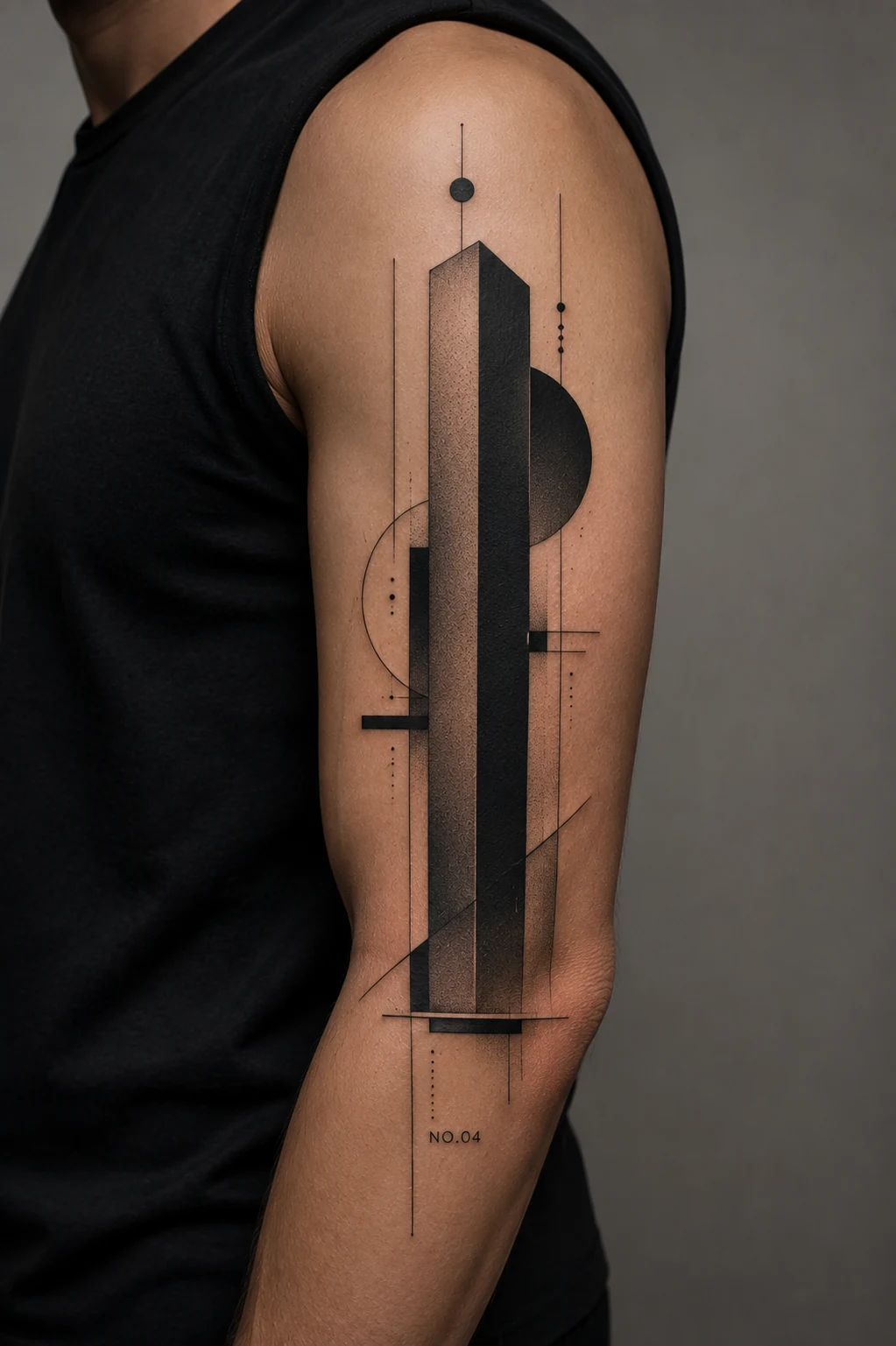
Monolith No. 04
- Artist
- Niko Vale
- Discipline
- Blackwork
- Placement
- Upper arm
- Scale
- Large
- Session profile
- Planned across sessions
A vertical architectural blackwork study balances a dominant mass with circles, thin axes, and a small NO.04 notation.
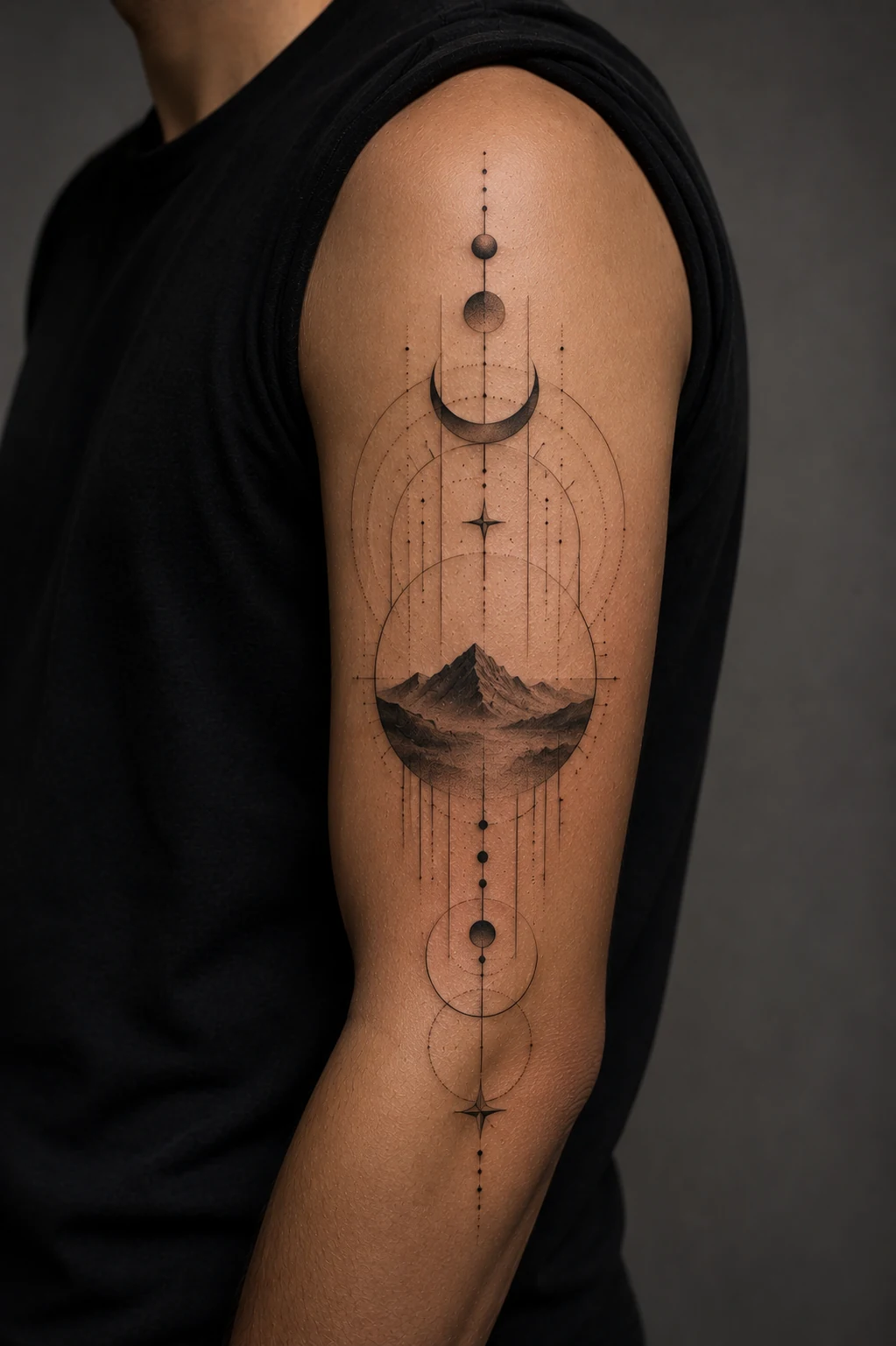
Veiled Narrative
- Artist
- Adrian Roe
- Discipline
- Illustrative
- Placement
- Upper arm
- Scale
- Large
- Session profile
- Planned across sessions
A restrained mountain fragment sits within a fine geometric veil of circles, crescents, and precise lines.

Second Skin
- Artist
- Adrian Roe
- Discipline
- Illustrative
- Placement
- Upper arm
- Scale
- Large
- Session profile
- Planned across sessions
A classical stone profile emerges through a wing, leaves, and broken sculptural layers in soft black and grey.